
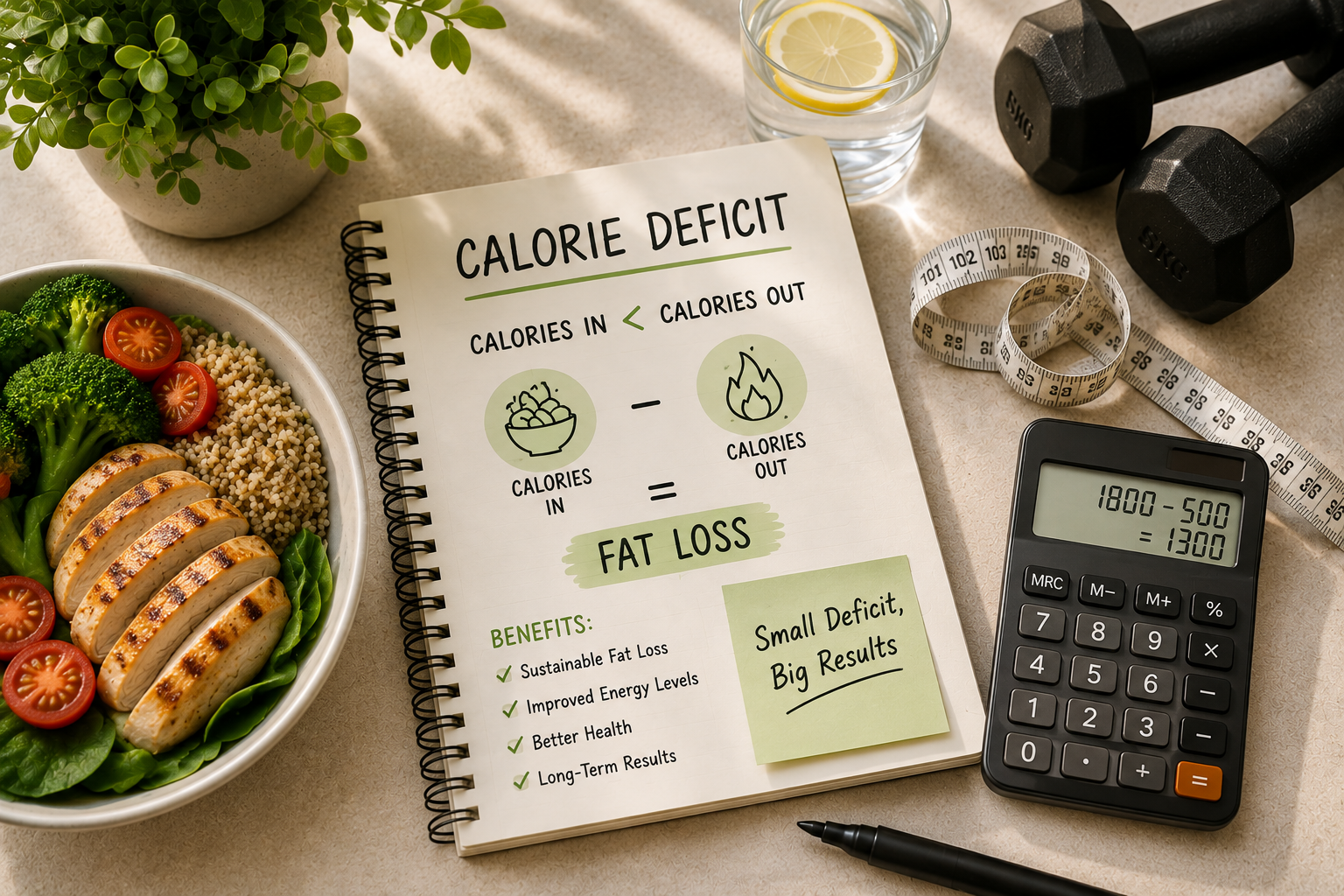
How to Create a Calorie Deficit for Fat Loss
Create a Calorie Deficit That Actually Works.
A calorie deficit is the foundation of fat loss—but bigger isn’t always better. The right deficit should help you lose body fat while keeping hunger, energy and training performance manageable.
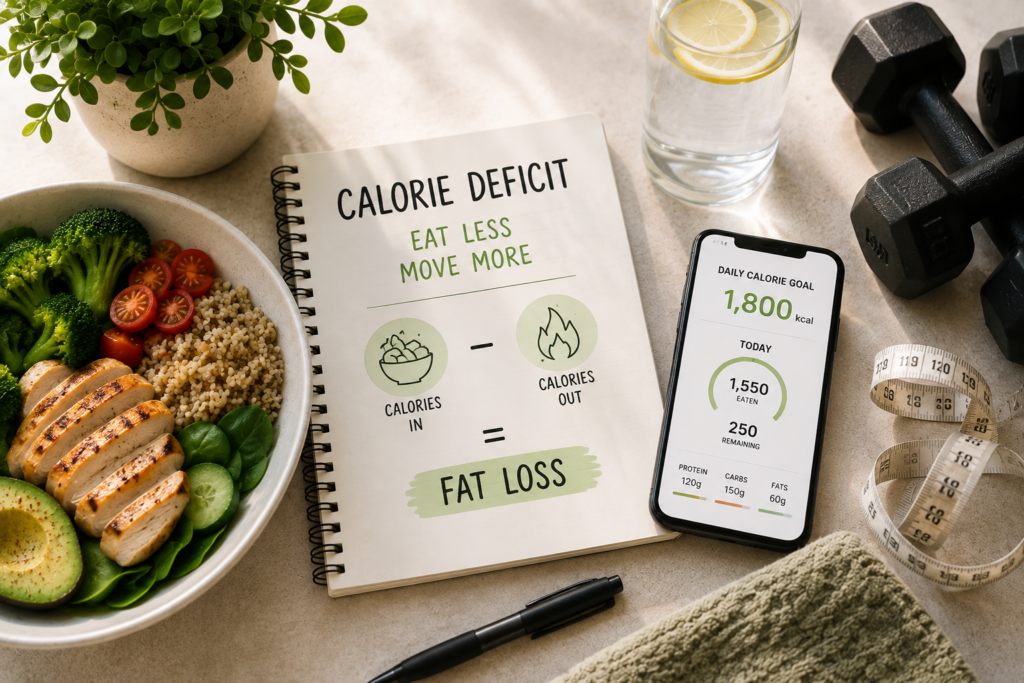
This guide explains how to estimate your calorie needs, choose an appropriate deficit and adjust your intake based on your real-world progress.
What Is a Calorie Deficit?
A calorie deficit occurs when your body uses more energy than you consume through food and drinks over time.
Your body requires energy every day for essential functions such as breathing and circulation, as well as digestion, everyday movement and exercise. When your calorie intake doesn’t fully cover these energy demands, your body must use stored energy to make up the difference.
Maintaining this energy deficit over time is what allows stored body fat to be reduced.
Calories In vs. Calories Out
At its simplest, changes in body energy stores are influenced by the relationship between energy intake and energy expenditure.
Calories in come from the foods and drinks you consume.
Calories out include energy used through:
- Basal metabolic functions
- Digestion
- Everyday movement
- Exercise and training
When calorie intake consistently falls below total energy expenditure, a calorie deficit is created.
Does a Calorie Deficit Always Mean Eating Less?
Not necessarily.
You can create or increase a calorie deficit by reducing calorie intake, increasing physical activity or combining both approaches.
For most people, a combination works well: make manageable changes to food intake while maintaining regular movement and exercise.
Trying to create the entire deficit through exercise alone can be difficult, while dramatically restricting food intake can make hunger, recovery and adherence harder to manage.
Quick Takeaway
A calorie deficit means consuming less energy than your body uses over time. The goal isn’t to create the largest possible deficit, but one you can maintain while supporting nutrition, training and recovery.
How to Calculate Your Calorie Deficit
Before creating a calorie deficit, you first need an estimate of how many calories your body uses each day. This is often referred to as your Total Daily Energy Expenditure (TDEE) or maintenance calories.
Your maintenance calories represent the approximate amount of energy you need to maintain your current body weight.
Once you know this number, you can reduce your calorie intake to create a controlled deficit.
Step 1: Estimate Your Maintenance Calories
Your daily calorie needs depend on several factors, including:
- Age
- Sex
- Height and body weight
- Daily activity
- Exercise and training
Instead of calculating everything manually, you can use the Nostrex Calorie Calculator to estimate your maintenance calories based on these factors.
Step 2: Choose a Reasonable Calorie Deficit
For many people, starting with a moderate deficit of around 10–20% below maintenance calories can be a practical approach.
For example:
| Estimated maintenance: | 2,500 calories/day |
| 15% calorie deficit: | 375 calories/day |
| Fat-loss target: | 2,125 calories/day |
This creates a meaningful deficit without unnecessarily cutting calories too aggressively.
Step 3: Monitor Your Progress
Your calculated calorie target is only a starting estimate.
Actual energy needs vary between individuals, so monitor your body-weight trend and other indicators over several weeks.
Daily weight can fluctuate because of water, carbohydrate intake, sodium, digestion and other factors. For that reason, looking at your average weight trend is generally more useful than focusing on individual weigh-ins.
If your average weight isn’t decreasing after several weeks of consistent tracking, your actual calorie deficit may be smaller than expected.
Adjust Gradually
Avoid making large calorie reductions based on a few days of scale data.
Instead, stay consistent and make small adjustments when necessary. This makes it easier to preserve adequate nutrition, training performance and adherence.
Quick Takeaway
Estimate your maintenance calories, start with a moderate 10–20% deficit and adjust based on your real-world progress—not just the calculator.
How Big Should Your Calorie Deficit Be?
A larger calorie deficit can lead to faster weight loss, but faster isn’t always better. Cutting calories too aggressively can increase hunger, reduce training performance and make a diet harder to maintain.
For most people, the goal should be to create a deficit that produces steady progress while still allowing enough food to support everyday life, nutrition and exercise.
Small vs. Moderate vs. Large Calorie Deficit
Here is a simple way to think about different deficit sizes:
| Calorie Deficit | Example at 2,500 kcal Maintenance | Best Suited For |
|---|---|---|
| 10% | 2,250 kcal/day | Slower, easier-to-maintain fat loss |
| 15% | 2,125 kcal/day | Balanced starting point for many people |
| 20% | 2,000 kcal/day | Faster progress with less dietary flexibility |
| 25%+ | 1,875 kcal/day or less | More aggressive and harder to sustain |
You don’t need to choose the largest deficit to get results. A moderate approach is often easier to follow consistently.
How Fast Should You Lose Weight?
A commonly used target during a fat-loss phase is approximately 0.5–1% of body weight per week.
For someone weighing 200 lb (91 kg), that would be roughly:
- 0.5%: 1 lb (0.45 kg) per week
- 1%: 2 lb (0.9 kg) per week
This isn’t a requirement. Some weeks may show more or less change because scale weight is influenced by water, glycogen and food intake as well as body fat.
People who are already relatively lean may benefit from aiming toward the slower end of the range.
Why Bigger Isn’t Always Better
An aggressive calorie deficit can make weight loss more difficult to sustain by increasing:
Hunger
Larger deficits can increase hunger and make sticking to your calorie target much harder.
Fatigue
Eating too little can reduce energy levels and make everyday activities feel much more difficult overall.
Performance
Large deficits can reduce workout performance and make maintaining strength harder.
Muscle retention
Losing weight too quickly can make it harder to preserve muscle during your fat-loss phase.
Adherence
Highly restrictive diets are often harder to maintain consistently over longer periods of time.
Focus on Sustainable Progress
Your ideal deficit depends on your starting point, activity level, goals and how you respond to dieting.
For many people, around 10–20% below estimated maintenance calories provides a sensible starting range.
You can then adjust your intake based on your weight trend, hunger, training performance and overall adherence.
Quick Takeaway
Start with a moderate calorie deficit rather than automatically choosing the most aggressive option. Consistent, sustainable fat loss is more important than losing weight as quickly as possible.
How to Create a Calorie Deficit Without Feeling Hungry
Hunger is one of the biggest challenges during a fat-loss phase. While some increase in appetite can be normal when eating fewer calories, your diet shouldn’t leave you constantly hungry.
The key is to choose foods and habits that provide more fullness for fewer calories.
Prioritize Protein
Protein is particularly useful during fat loss because it can help with satiety while also supporting the maintenance of muscle mass.
Build most meals around a quality protein source such as:
- Chicken or turkey
- Eggs
- Greek yogurt
- Cottage cheese
- Fish
- Lean beef
- Tofu or tempeh
- Beans and lentils
A practical approach is to include a meaningful source of protein at every main meal.
Eat More High-Volume Foods
High-volume foods allow you to eat larger portions without consuming excessive calories.
Vegetables, fruits, potatoes, soups and salads can add substantial volume to your meals while helping you stay within your calorie target.
For example, replacing a small portion of calorie-dense food with vegetables can significantly increase the overall size of your meal.
Get Enough Fiber
Fiber-rich foods generally take longer to digest and can help meals feel more satisfying.
Good sources include:
Vegetables • Fruits • Whole grains • Beans • Lentils • Potatoes • Oats
Instead of relying heavily on highly processed foods, build most of your diet around minimally processed foods that provide protein, fiber and micronutrients.
Watch Liquid Calories
Calories from drinks can add up quickly without providing the same fullness as solid food.
Soft drinks, juices, specialty coffees and alcoholic beverages can make maintaining a calorie deficit more difficult.
Choosing water, sparkling water, unsweetened tea or low-calorie drinks can free up more of your daily calories for filling meals.
Build Satisfying Meals
Rather than simply making every meal smaller, structure meals around foods that provide both nutrition and volume.
A simple fat-loss plate could look like:
½ Vegetables
¼ Lean Protein
¼ Potatoes, Rice or Whole Grains
+ A Small Portion of Healthy Fats
This isn’t a strict rule, but it provides an easy framework for creating balanced, filling meals.
Quick Takeaway
Don’t just eat less—make your calories work harder. Prioritize protein, fiber and high-volume foods so you can create a calorie deficit while still eating satisfying meals.
How to Maintain Muscle in a Calorie Deficit
When losing weight, the goal shouldn’t simply be to make the number on the scale go down. Ideally, you want to lose body fat while preserving as much muscle as possible.
A well-planned calorie deficit, sufficient protein and resistance training can help you maintain lean mass throughout your fat-loss phase.
Eat Enough Protein
Protein becomes especially important when you’re consuming fewer calories.
A practical target for active people during fat loss is approximately 1.6–2.2 grams of protein per kilogram of body weight per day.
For someone weighing 80 kg (176 lb), that would be roughly:
128–176 g of protein per day
You don’t need to consume your entire protein target in one or two meals. Spreading protein across several meals throughout the day can make reaching your target easier.
Keep Strength Training
Resistance training gives your body a strong reason to maintain muscle while you’re losing weight.
Continue training your major muscle groups and aim to maintain your strength as much as possible.
Your workouts don’t need to become dramatically harder just because you’re dieting. Instead, focus on consistent, high-quality resistance training.
Avoid an Excessive Deficit
The faster you try to lose weight, the harder it can become to maintain muscle and training performance.
This is another reason why a moderate calorie deficit is often preferable to aggressive calorie restriction.
If your strength, recovery and energy levels decline significantly, your deficit may be more aggressive than necessary.
Prioritize Recovery
Recovery still matters during fat loss.
Getting enough sleep and allowing adequate recovery between workouts can help support training performance while calories are reduced.
Try to maintain consistent sleep habits and avoid compensating for lower calorie intake by dramatically increasing your training volume.
Monitor More Than Your Weight
Alongside your average body weight, consider monitoring:
- Waist measurements
- Progress photos
- Gym performance
- How your clothes fit
If your waist measurement is decreasing while your strength remains relatively stable, that’s generally a more useful sign of progress than scale weight alone.
Quick Takeaway
Combine a moderate calorie deficit with sufficient protein, consistent strength training and adequate recovery to help preserve muscle while losing body fat.
Common Calorie Deficit Mistakes
Creating a calorie deficit sounds simple, but several common mistakes can make fat loss harder than it needs to be. Avoiding these problems can help you stay consistent and get a clearer picture of your actual progress.
Cutting Calories Too Aggressively
More isn’t always better.
Starting with a very large deficit may produce faster initial weight loss, but it can also increase hunger, fatigue and difficulty maintaining your diet.
Instead, begin with a moderate deficit and only make further adjustments when your progress genuinely requires them.
Underestimating Your Calorie Intake
Small amounts of food can contain more calories than expected.
Cooking oils, sauces, dressings, snacks and drinks are particularly easy to overlook. Even small portions can add up across the day.
You don’t need to track every calorie forever, but temporarily measuring portions can help you better understand how much you’re actually eating.
Eating Back Every Exercise Calorie
Fitness trackers and cardio machines can provide useful activity data, but their calorie-burn estimates aren’t perfectly accurate.
Automatically eating back every estimated calorie burned during exercise can unintentionally reduce or eliminate your deficit.
It’s usually better to base your calorie target on your overall activity level rather than constantly adjusting your food intake after individual workouts.
Reacting to Daily Scale Changes
Body weight naturally fluctuates.
A higher weigh-in doesn’t necessarily mean you’ve gained body fat. Changes in water retention, sodium, carbohydrates, digestion and food volume can move the scale considerably from one day to another.
Focus on your weight trend over time rather than individual measurements.
Ignoring Weekends
Eating in a deficit Monday through Friday doesn’t guarantee that you’ll remain in a deficit across the entire week.
For example, a 400-calorie daily deficit for five days creates a 2,000-calorie weekly deficit. Two higher-calorie days can significantly reduce or completely erase it.
Consistency across the week matters more than having a few “perfect” days.
Changing Your Plan Too Quickly
Fat loss isn’t perfectly linear.
If the scale doesn’t move for several days, that doesn’t automatically mean your calorie target needs to change.
Follow your plan consistently and evaluate your average weight trend over multiple weeks before making meaningful adjustments.
Quick Takeaway
Successful fat loss depends more on consistency than perfection. Track the overall trend, avoid extreme adjustments and give your calorie deficit enough time to work.
How to Know If Your Calorie Deficit Is Working
A calorie calculator gives you a useful starting point, but your real-world progress determines whether you’re actually in a calorie deficit.
Instead of judging your diet by a single weigh-in, look for consistent trends over several weeks.
Your Average Weight Is Decreasing
The clearest sign that your calorie deficit is working is a gradual downward trend in body weight.
Because weight can fluctuate significantly from day to day, consider weighing yourself under similar conditions and comparing weekly averages rather than individual measurements.
For example:
Week 1 average: 82.4 kg
Week 2 average: 82.0 kg
Week 3 average: 81.6 kg
Even if some individual weigh-ins increase, the overall trend shows that weight is moving downward.
Your Waist Measurement Is Decreasing
The scale isn’t your only useful measurement.
Tracking your waist every few weeks can provide additional information about changes in body composition.
If your body weight is moving slowly but your waist measurement is decreasing, your fat-loss plan may still be progressing well.
Your Clothes Fit Differently
Changes in how your clothes fit can sometimes become noticeable even when scale progress appears slow.
A looser waistband or improved fit around your midsection can provide another simple indicator that your body composition is changing.
Your Strength Is Relatively Stable
Some variation in gym performance is normal during a calorie deficit.
However, maintaining most of your strength while your weight and waist measurements gradually decrease is generally a positive sign—especially when your goal is to preserve muscle while losing fat.
When Should You Adjust Your Calories?
Don’t reduce calories because your weight hasn’t changed for a few days.
First, make sure you’ve been following your calorie target consistently and allow enough time for normal weight fluctuations to settle.
If your average body weight and measurements haven’t changed for around 2–3 weeks, despite consistent adherence, you may need to make a small adjustment.
You could:
- Reduce calorie intake slightly
- Increase daily movement
- Add some additional activity
Avoid making several major changes at once. Small adjustments make it easier to determine what actually works.
Don’t Change a Plan That’s Working
If your weight trend is gradually decreasing, your waist is getting smaller and your diet remains manageable, there is usually no reason to reduce calories further.
Faster weight loss isn’t automatically better.
Continue with the same calorie target for as long as it produces sustainable progress.
Quick Takeaway
Use weekly weight averages, waist measurements and training performance to evaluate progress. If your current calorie deficit is working, don’t make it more aggressive.
Do You Need to Count Calories to Be in a Calorie Deficit?
No. You don’t have to count every calorie to lose body fat.
A calorie deficit is determined by the relationship between how much energy you consume and how much your body uses—not whether you track those calories in an app.
However, calorie tracking can be a useful tool for understanding portion sizes and identifying where your calories are coming from.
When Calorie Tracking Can Help
Tracking your food for a period of time can give you a clearer picture of your normal eating habits.
It can help you:
- Understand portion sizes
- Identify calorie-dense foods
- Monitor protein intake
- Recognize hidden calories
- Build more consistent meals
For beginners, even tracking for a few weeks can improve awareness of how different foods contribute to daily calorie intake.
You Can Lose Fat Without Tracking
If you prefer not to count calories, you can still create a calorie deficit by making your meals more structured.
A simple approach is to:
Build meals around protein
Include a quality protein source with each main meal.
Fill more of your plate with vegetables
They add volume while generally providing relatively few calories.
Choose mostly minimally processed foods
These can make it easier to build filling meals around protein, fiber and nutrient-dense ingredients.
Control calorie-dense extras
Be mindful of oils, sauces, dressings, nuts and other foods that can add significant calories in small portions.
Keep portions consistent
Using similar meal structures can make your overall calorie intake more predictable.
Tracking Doesn’t Need to Be Permanent
Calorie tracking should be viewed as a tool rather than a requirement.
Some people enjoy the precision it provides, while others prefer using portion sizes, meal templates or consistent food choices.
You can also use tracking temporarily to learn what appropriate portions look like and then transition toward a less structured approach.
What Matters Most?
Whether you count calories or not, the underlying requirement for fat loss remains the same: your average energy intake needs to remain below your average energy expenditure over time.
Choose the method that makes this easiest for you to maintain consistently.
Quick Takeaway
You don’t need to count calories to lose fat. Tracking can improve awareness and precision, but consistent portions, protein-rich meals and smart food choices can also help you maintain a calorie deficit.
Frequently Asked Questions
Final Thoughts
A calorie deficit is the foundation of fat loss, but it doesn’t need to mean extreme restriction or constantly feeling hungry.
For most people, the best approach is to start with a moderate calorie deficit, prioritize protein and filling foods, continue strength training and monitor progress over time.
Remember that calorie calculations are only estimates. Your real-world results—such as your average weight trend, waist measurements and training performance—will tell you whether your current approach is working.
Focus on consistency rather than trying to lose weight as quickly as possible. A calorie deficit you can maintain is far more useful than an aggressive plan you can’t sustain.
Ready to Find Your Calorie Target?
Use the Nostrex Calorie Calculator to estimate your maintenance calories and get a personalized daily calorie target based on your body, activity level and goal.
Related Guides
The Ultimate Fat Loss Guide
Learn practical fat loss strategies to lose body fat, preserve muscle and reach your fitness goals.